Table of contents
In every property cycle, there is one address that, by the second quarter of the year, has already absorbed a disproportionate share of the international real estate conversation. It is the project that brokers describe, in the language of their trade, as the one their clients are asking about by name. It is the project that recurs in the editorial pages of the regional press, in the analyst notes of the consultancies, and in the private conversations of the family offices that move quietly through the world’s prime markets. In 2026, that address is on the Dubai Water Canal, in the Al Wasl district, and it is called Amali Residences.
What follows is an attempt to decode why.
The Layered Reasons
Most luxury launches are sold on a single argument. The architect. The brand. The view. The address. The amenities. The market has, over time, become reasonably skilled at evaluating each of these arguments in isolation. What is more difficult, and what the most consequential launches tend to deliver, is a project whose argument is layered. The first reading is straightforward. The second reveals something more. The third reveals something more again.
Amali Residences is, on most measures, a layered project. The surface reading delivers the architectural signature of Killa Design, the interior architecture by HBA Residential, the canal-front Al Wasl location, and the family backing of the Sajwani siblings through Amali Properties and AHS Properties. The second reading reveals the material specification, the 5.5 metre floor-to-floor heights, the private pool at every residence, and the amenity programme across the three podiums. The third reading reveals the 60/40 payment structure, the Q4 2029 handover, the Golden Visa eligibility, the tax frame, and the secondary-market implications of a launch of this velocity.
Each layer is, on its own, a reason for the conversation. The combination is the reason for the volume of the conversation.
The Three Podiums
The amenity programme at Amali is structured around three distinct podiums, each with its own editorial identity. The Social. The Club. The Retreat. The vocabulary is itself worth pausing on, because it represents a shift in how Dubai’s ultra-prime developers have begun to think about residential amenities.
For most of the last decade, Dubai’s amenity programmes have been delivered as a single, undifferentiated stack. A gym. A pool. A lounge. A multi-purpose hall. A children’s play area. The vocabulary was functional rather than editorial. The result, in most projects, was a programme that delivered the boxes but did not, in any meaningful way, define a residential lifestyle.
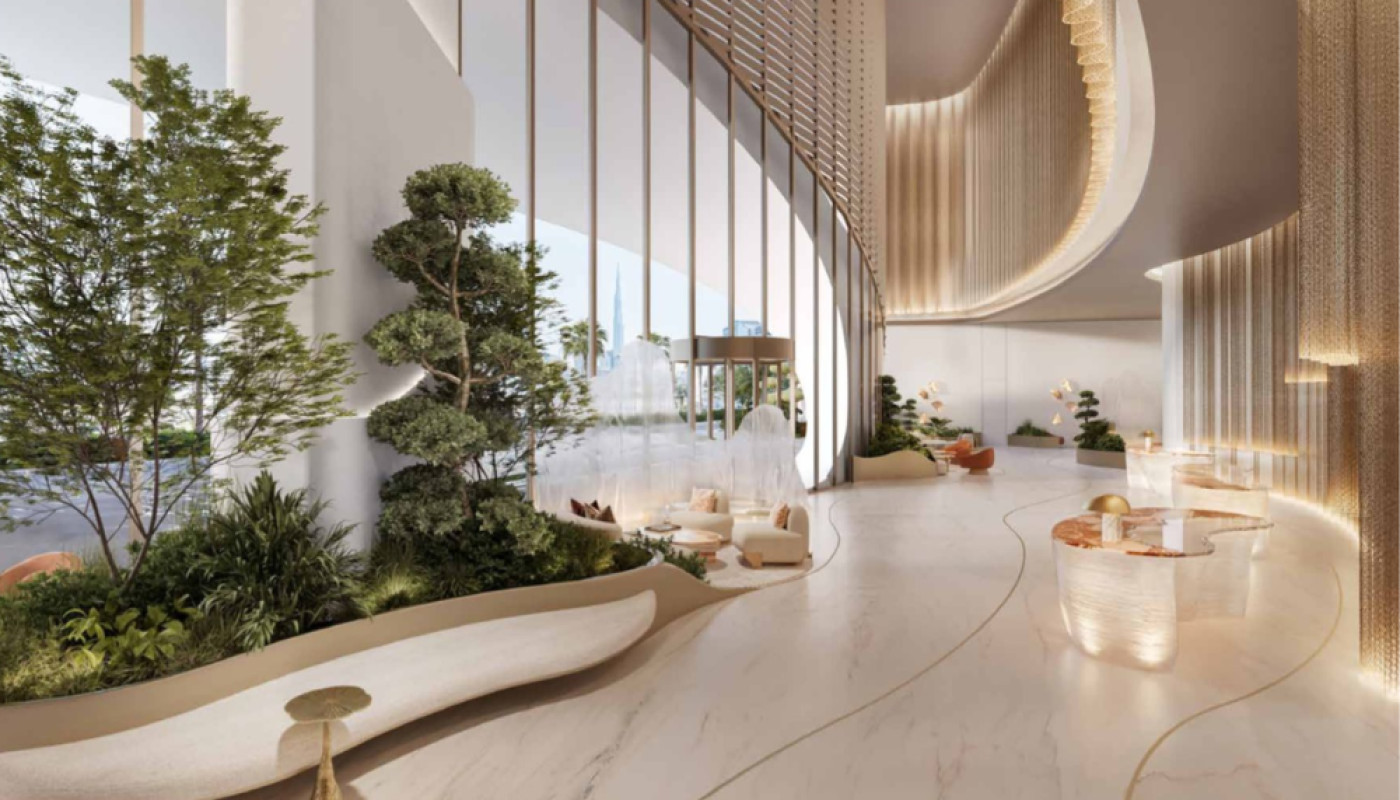
The Amali approach is closer in spirit to the curated amenity programmes of the most serious international branded residences. The Social podium handles the moments of resident interaction that benefit from a structured social environment. A cigar lounge. A private cinema. A music room. A boarding suite for visiting guests. The Club podium handles the more performative amenities. The padel court. The bowling alley. The gym. The swim-through pools. The Retreat podium handles the quieter spaces. The library. The screening room with its starlight ceiling. The kids club. The spaces where the residents are expected to retreat into a more private register.
The total amenity footprint is 54,648 square feet, distributed across these three podiums. The dimension is significant. Most Dubai ultra-prime projects allocate between 25,000 and 40,000 square feet to amenities. The Amali specification places it within the upper band of the international branded-residence comparison set.
The Private Pool Philosophy
The decision to deliver a private pool at every residence, from the 2-bedroom floor plate upward, is one of the most editorial decisions the project has made. It is also, in practical terms, one of the most difficult.
A private pool at the apartment level is a structural specification, not a finishing one. It requires the floor plate to be designed around it. It requires the slab to carry the load. It requires the building services to deliver water, drainage, filtration, and heating to every individual unit. It requires the architectural facade to express the pool’s terrace in a way that does not visually fracture the building’s elevation. Most Dubai luxury towers solve the problem only at the penthouse band, where the structural and design implications can be contained.
Extending the specification across all 211 residences requires a different design discipline. It changes the building’s mechanical, structural, and architectural design from the foundation upward. The decision, in other words, is not a marketing addition. It is a structural commitment that has shaped the project’s entire engineering response. AE7, the engineering firm working on the project, has been engaged from the early design phase to deliver that response.
The cultural significance of the private pool decision is worth noting. The Dubai climate, with its summer extremes and its short cooler season, is a climate in which the private outdoor moment is, paradoxically, both highly valued and difficult to deliver. The combination of a private pool, a 5.5 metre ceiling height, and a deep terrace produces an indoor-outdoor relationship that, in the apartment typology, is rare. It is closer to a stacked villa than to a conventional tower residence.
Materials Sourced from Italy and Turkey
The material specification at Amali draws, deliberately, from the European stone tradition. The lobbies, the lift cores, the common areas, and the principal interior surfaces are clad in a palette that includes Mother-of-Pearl marble, Rosso Orobico, Cipollino Verde, and Blue Mountain marble. Each of these is a stone with a specific provenance and a specific history in the European luxury architecture canon.
Mother-of-Pearl marble, with its iridescent surface and its low-saturation tonal range, is most often associated with the contemporary Italian and Greek hospitality interior tradition. Rosso Orobico, an Italian marble with a deep red-brown veining, has been used in the historic palazzo interiors of Lombardy and in the contemporary residences of Milanese and Roman luxury developers. Cipollino Verde, a green-veined Italian marble with a long classical history, is one of the materials that recurs in the principal staircases and lift halls of the European grand hotels. Blue Mountain marble, a Turkish stone with a layered blue-grey veining, has, over the past decade, become one of the more sought-after specifications in the international ultra-prime interior canon.
The selection of this palette places Amali, in material terms, inside the tradition of the European grand residence rather than inside the tradition of the contemporary Dubai tower. The decision is consequential. Material is, in luxury architecture, the longest-running argument. It is the surface a buyer touches every day. It is the specification that does not go out of fashion. A residence specified at this level is, in effect, designed to remain credible to its buyers for a generation.
The kitchen specification follows the same logic. Gaggenau, the German appliance manufacturer that has, over the past two decades, become the default specification of the world’s most serious residential projects. The ironmongery, the door handles, the lock plates, the cabinetry hardware, is by Joseph Giles, the London house whose work is present in the residences of Claridge’s, One Hyde Park, and the principal addresses of London’s prime postcodes.
The 60/40 Payment Psychology
The 60/40 payment structure, with 60 percent payable across the construction window through Q4 2029 and 40 percent payable on handover, is the element of the project that most explicitly conforms to Dubai market convention. It is also, in psychological terms, one of the most important variables in the project’s commercial success.
The structure produces a number of effects. First, it reduces the day-one cash outlay required to acquire a unit. The buyer commits, at launch, to a payment schedule rather than to a full transaction. The Dubai Land Department fee of 4 percent is paid at reservation, and the remainder is spread across the construction period.
Second, it aligns the buyer’s cash deployment with the construction milestones. The payments are tranched against the project’s progress. The buyer’s exposure to the project rises as the project itself rises. The structure, in effect, transfers a portion of the project’s construction risk into the developer’s balance sheet and away from the buyer’s.
Third, and most importantly for international buyers, it produces a structure within which the buyer’s eventual handover payment can be financed against the project’s value at delivery rather than against the project’s value at launch. For a buyer acquiring a unit in 2026 with a Q4 2029 handover, the handover-stage value of the property is the relevant variable for financing, and that value is, in the brokerage community’s published commentary, expected to be materially above the launch pricing.
The combination of these three effects produces a payment structure that is, for the right buyer, an enabling feature rather than a constraint. It is the reason Dubai’s launches at this scale continue to be absorbed at a velocity that, in markets with full-cash-at-launch conventions, would be impossible.
The Investment Frame
The macro-economic frame around Dubai prime remains, in 2026, structurally favourable. The Knight Frank Wealth Report has, for several consecutive editions, identified Dubai as one of the global cities with the highest concentration of cross-border ultra-high-net-worth flows. JLL has continued to flag the structural undersupply of architecturally led and branded inventory in the city’s prime market. Bayut and Property Finder have, in their weekly and quarterly data, reported a sustained price corridor in the Al Wasl and broader Dubai Water Canal area.
The UAE Golden Visa, available at the AED 2 million property threshold, has continued to pull long-stay capital into the city. The federal tax regime, with no personal income tax and no capital gains tax on residential property, remains a competitive differentiator against the European and North American prime markets. Freehold ownership is available to foreign buyers across the relevant zones, including the Al Wasl postcode in which Amali is located. According to recent Knight Frank analysis, prime Dubai residential yields hover near 5 percent on an indicative basis, a figure that remains materially above the comparable yields in central London, Paris, or Manhattan prime.
For a buyer evaluating the Dubai Water Canal project as a long-term hold, the combination of these variables is the structural argument. The product specification is the editorial argument. The two arguments, together, account for why the launch has registered the absorption velocity it has.
The Architectural and Familial Provenance
It is worth restating, in conclusion, the provenance stack that the project is built on. Killa Design as the architect, the studio behind the Museum of the Future. HBA Residential as the interior architect, the residential arm of Hirsch Bedner Associates. SquareM Design as the landscape architect. AE7 as the engineer. Amali Properties and AHS Properties as the developers, led respectively by Amira and Ali Sajwani and by Abbas Sajwani, the three siblings who represent the next generation of one of the Gulf’s most consequential real estate families.
The combination of that provenance stack, on a single site, on the most coveted stretch of the Dubai Water Canal, at a launch price floor of AED 14.5 million for a 2-bedroom unit, with a private pool specification across all 211 residences, with a 54,648 square foot amenity programme across three podiums, with a 60/40 payment plan and a Q4 2029 handover, is the editorial assemblage that has made the Sajwani family’s new flagship the address of the year.
The Quiet Argument
What is most striking about the project, on a final reading, is how quietly it presents its argument. The launch has not been accompanied by the kind of high-volume media stunt that has, in recent cycles, marked other Dubai ultra-prime reveals. The communications strategy has been restrained, almost minimalist. The product specification has been allowed to do the talking. The brokerage community has been allowed to set the tempo of the conversation.
That restraint is, in luxury terms, the most confident form of marketing. It is the strategy of a project whose principals have decided that the product itself is the argument, and that the volume of the conversation will, in time, take care of itself.
By the second quarter of 2026, the volume of the conversation has, indeed, taken care of itself. The address has become, in the language of the international ultra-prime market, the one that the cycle will be remembered by. The handover is still three and a half years away. The conversation about what the building will mean, when it is delivered, has already begun.
On the same subject